Where Does Space Actually Begin?
The atmosphere becomes thinner continuously with altitude rather than ending at a sharp boundary.
A. From Class
This question arose while connecting orbital altitude to the environment surrounding a spacecraft. It is tempting to imagine a sharp surface above which space begins, but the atmosphere instead becomes progressively thinner. That matters because even spacecraft hundreds of kilometres above Earth encounter enough residual gas to experience measurable drag.
B. Explore the Idea
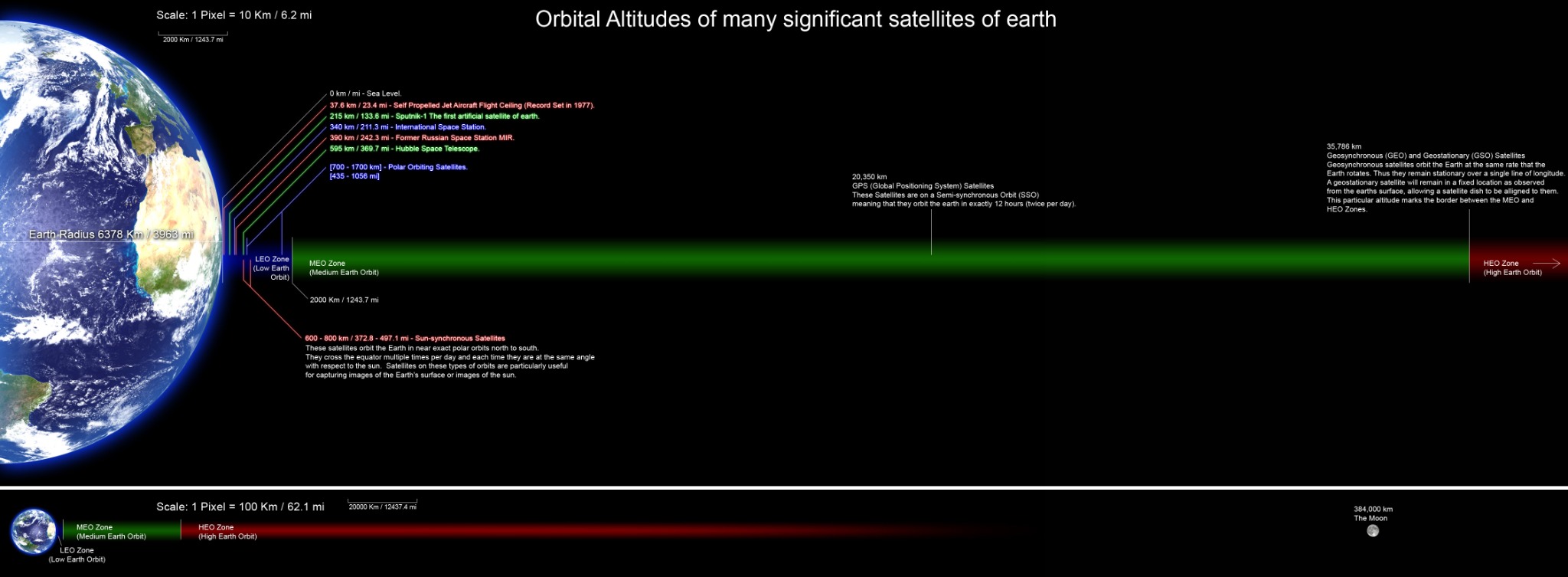
The Kármán line at 100 km is a widely used conventional boundary, not the physical end of the atmosphere. Above it, aerodynamic lift is no longer a practical basis for ordinary flight, yet atmospheric particles remain. The thermosphere includes many low-Earth-orbit altitudes, and the extremely tenuous exosphere extends much farther. At ISS-like altitudes, roughly 400 km, residual drag gradually removes orbital energy and periodic reboosts are required. Where “space begins” therefore depends on the purpose of the definition: legal or operational conventions may use a specific altitude, while atmospheric physics describes a continuous decrease in density rather than an abrupt edge.